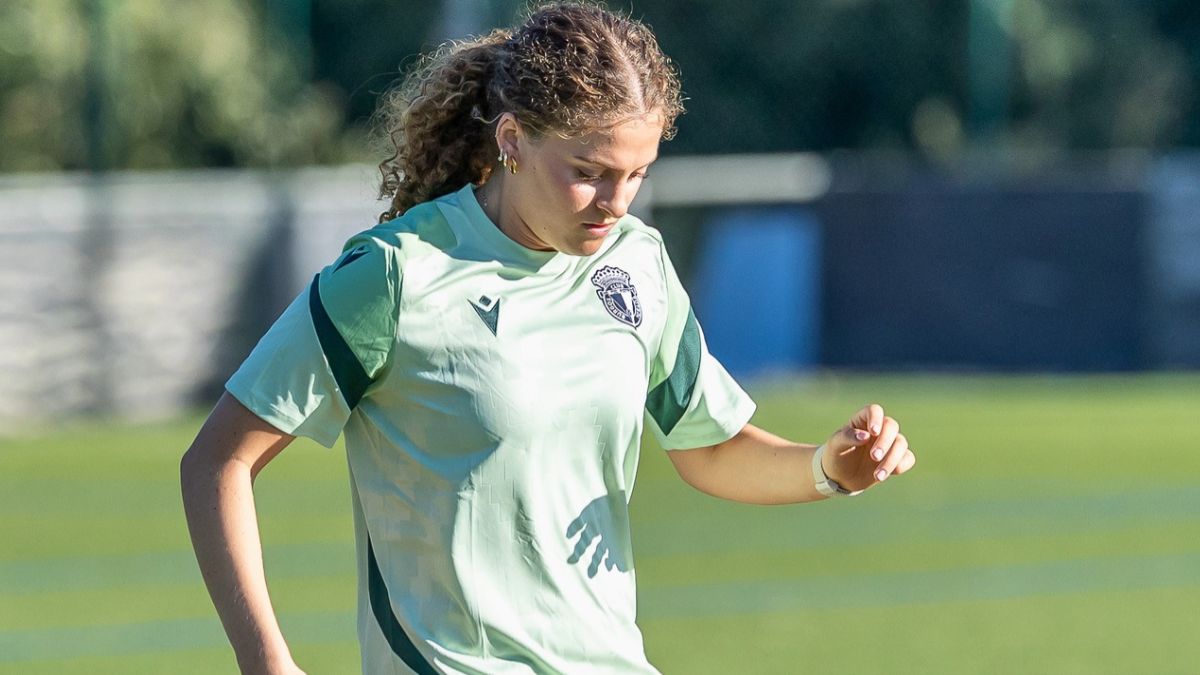
Born in Houston, Texas, Michelle Polo has made the move from American college soccer to European football, joining Burgos CFFF for her first season in Spain. After three seasons with the UTSA Roadrunners, she is embracing a new challenge, adapting to a different style of play and discovering a new culture while continuing to grow both on and off the pitch.
- To start, how would you describe yourself as a footballer, and what do you consider your main strengths as a forward?
First, I would say I’m a very hard worker. My main goal in a game is to give everything I can while playing with humility. My faith in God is very important to me, and it is what I credit my performance to. Technically, I love having the ball at my feet, combining with other players, playing daring passes, shooting with power, and getting into positions to cross the ball. Tactically, I try to be creative by making unique movements off the ball or creating different situations on the field. I believe I can play well off other players.
- You were born in Houston and developed much of your football career in the United States. How did you get started in football, and what made you want to pursue it professionally?
My parents put me into football when I was around five years old. There wasn’t much of a connection to the game in my family in terms of players, but with Spanish and Argentinian roots, they were always fans. Once I started playing football, it stuck and became my main focus. When I was little, I wanted to be Messi when I grew up.
Later, in high school, I wasn’t as interested in pursuing professional football because I saw it as a lifelong career. In college, I was able to watch some of my older teammates go off to play in various countries. It was very inspiring to see them live their dream and immerse themselves in a new culture.
When I realized I could graduate from college in three years, I dreamed of playing in Spain for my “fourth” year. For most of my life, I had also wanted to live or study abroad in Spain. Playing fútbol in Spain was the best of both worlds: I could continue playing the sport I loved while experiencing a new culture. It was very exciting to take that next step.
- You spent three seasons playing for the UTSA Roadrunners in American college soccer. What did that experience teach you, both on and off the pitch?
College football impacted me in countless ways. Playing football as a child already teaches you discipline, teamwork, and community. I believe college football is very professional, and I’m grateful to have been held to that standard.
It was made clear to us that we were blessed to be in that position. Every practice or obligation was something we got to do rather than had to do. Although we were students first, being an athlete was a complete lifestyle.
We were taught much more about life off the pitch. Meetings were meant to help us understand and inspire each other. One of the main goals was to “leave the jersey in a better place.” As much as we would inevitably be affected by the experience, I was taught to give everything I could in every circumstance. How you show up in one area of your life is usually how you show up in all areas.
- This season, you made the move to Europe to join Burgos CFFF. How did the opportunity come about, and what convinced you to come to Spain?
It had been my plan for a while to play in Spain, especially once I decided to make my third year of college my senior year. I began putting clips together and doing more research in January of this year. However, I still needed to graduate in May, so I planned to start playing in Spain when the league began in late summer.
I felt I had done everything I could by reaching out and getting help from coaches, but I didn’t really have any offers yet. I also wasn’t sure about having an agent at the time.
After a couple of months playing summer league, I was offered the opportunity to play in Burgos through Proneo and ESUS. That was how I discovered Proneo and signed with them. It all came together thanks to my very helpful UTSA coaches, Scott and Derek!
In my mind, and whenever I told anyone about my plans, Spain was always my favourite destination. I was so happy that it could finally become a reality. It was even better to have Dani from Proneo care so deeply and make me feel comfortable with the opportunity. Manolo from ESUS was also a great help with the transition from the US to Spain.
I didn’t need any convincing. I remember feeling so grateful to God for this opportunity and praying that it would be the best decision.
- American and Spanish football have different playing styles, approaches to development, and competitive environments. What differences have you noticed so far, and what has surprised you the most?
From the beginning, I noticed how different the training sessions were. In general, the exercises weren’t typical of what I would do in the US. The game here is definitely a little more tactical, with less time on the ball than I was used to.
However, football in Spain is also different because it is played at a professional level rather than in a school environment. Almost everything, right down to match-day routines, is different. Things are more relaxed here than in the US.
I’ve described football here to some people as being a part of life, whereas in the US, it was something you got to do, even though we committed so much time to it.
The transition was difficult at first because I had to understand a different style of play and a lot of football slang. I think things have improved considerably over time, and I can understand more from context than I could before.
I was surprised by how aggressive Spanish football is, both in training but especially in matches. I’ve been told that this is characteristic of football in northern Spain. It was difficult to adjust because, although I’m physically strong, I wasn’t used to taking so many hits. I remember my back always hurting after games in the beginning. The referees allow a lot of contact, which changes how matches unfold. Since then, I’ve learned to anticipate it and adapt.
- Moving to a new country means adapting to a different language, culture, and way of life. How have your first months in Burgos been, and what do you miss most about home?
It was very exciting at first. I enjoyed learning about the different, and sometimes slower, way of life. So many things were the opposite of what we do in the US. I love how people here feel less like strangers.
I’m still not used to eating so late, though! Once I had taken care of certain essentials, such as getting my eSIM and identification sorted out, I started to feel more settled. So many people here have supported me and cared about my well-being.
There have definitely been some difficult moments, too. I moved to another country, but I’m also going through the transition of finishing school and leaving behind the football system I’ve played in my whole life.
I miss my family the most. Being away is hard, and the time difference sometimes makes it difficult to talk. I miss my friends, too. At the same time, learning more about Spanish culture and the language has been really cool.
I do miss being able to immediately understand everything around me. Grocery shopping was difficult at first because I care about ingredients and nutrition.
I didn’t expect so few people to prioritize God here, especially with so many churches around. I miss having more of that in my everyday life in the US.
Spain has so much diversity, and I’m excited to explore more cities. I’m grateful to be learning more about my family’s roots. There is so much beauty, history, community, and a strong sense of family here.
- Finally, what personal goals have you set for your first season with Burgos CFFF, and where would you like to see yourself in a few years? Do you dream of reaching Spain’s top division or representing the United States national team?
My goal was to make an impact both on and off the field in a way they might not be used to. I’m the only player from the US, and I come from a different style of football. Naturally, I want to contribute to wins, but I also hope my character leaves a lasting, Godly impression.
Honestly, I’m not sure where I see myself yet. I feel that I always want to have control over my future, but I’m learning to leave it more in God’s hands.
I love football and how much it has impacted my life. I’m not sure when I’ll return to the US. I will go back, but I’m not done here yet. I see football, in one form or another, being part of my future.