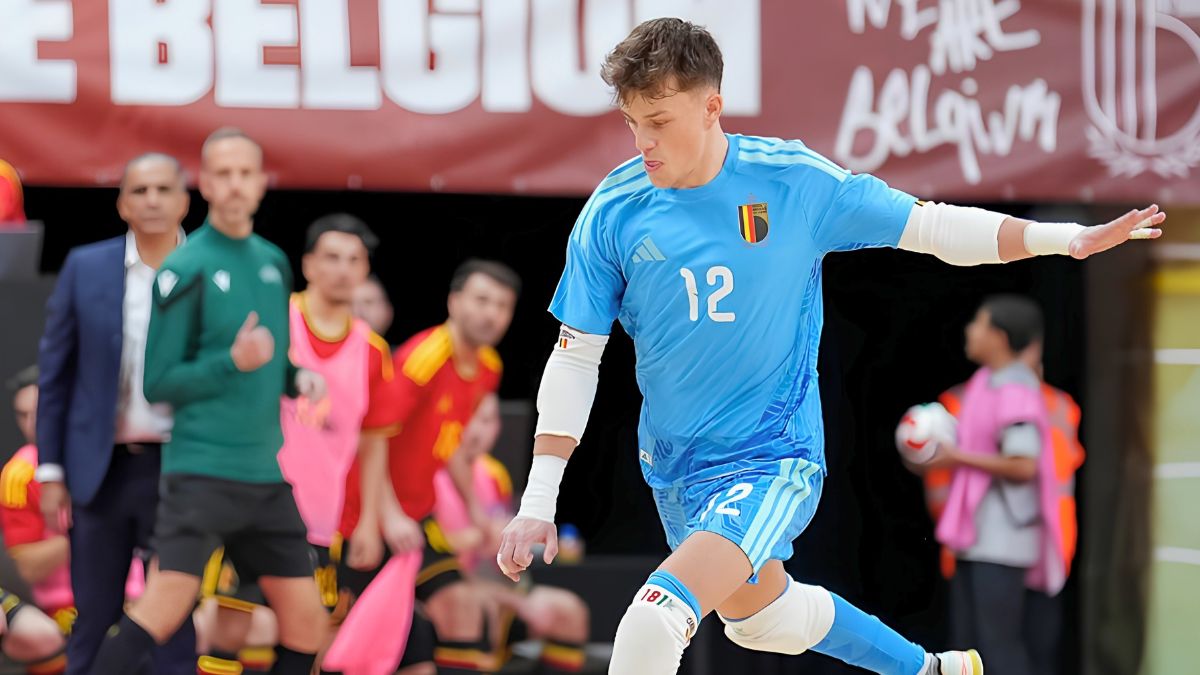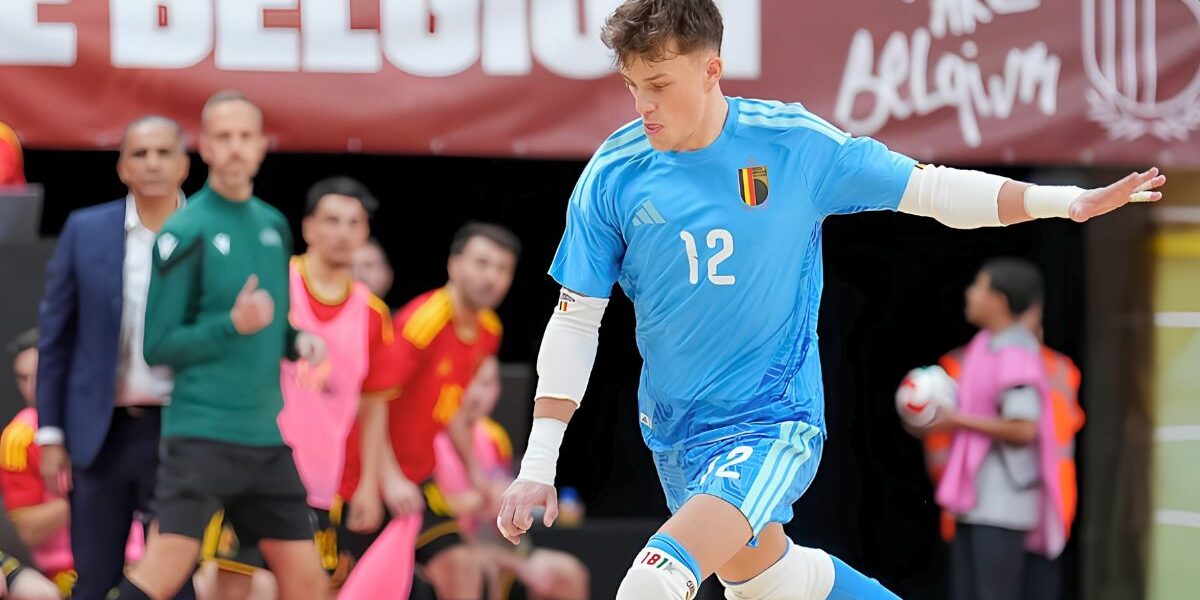
The Anderlecht goalkeeper reflects on his journey from the club’s youth system to the first team, the lessons learned from world-class teammates and his ambitions with the Belgian national team and in the UEFA Futsal Champions League.
Tom Cardoen has come a long way since his early days in Anderlecht’s youth system. Now in his fourth season with the first team, the young goalkeeper continues to develop alongside some of the best players in world futsal, driven by the ambition to establish himself as a key figure at RSCA Futsal and represent Belgium on the international stage.
In this interview, Cardoen discusses what it means to wear the shirt of the club he has supported since childhood, the qualities that define a modern futsal goalkeeper and the steps Belgian futsal needs to take to compete with Europe’s leading nations.
- What does it mean to represent such a historic club as Anderlecht, and how special is it to have earned this opportunity through your own development?
Anderlecht has always had a special place in my heart. I’ve been a supporter of the club for as long as I can remember, a passion that was passed down to me by my father. So when FP Halle-Gooik became RSCA Futsal, something that had always seemed like a distant dream suddenly became a real possibility: one day, I could wear the Anderlecht shirt myself. Having the opportunity to represent the club I’ve supported since childhood means a lot to me, and it’s a feeling I never want to take for granted.
Making my way from the youth teams to the first team wasn’t easy, especially at a club of this level. Discipline, patience and hard work are values I was taught at home, and they’ve been essential throughout that journey. I’m grateful to now be in my fourth season with the first team.
Wearing this badge is something I’m extremely proud of. I share the club’s ambition to keep growing and competing at the highest European level. And, of course, representing our incredible supporters makes it even more special. The support they showed during our last Champions League campaign was another reminder of what this club means to so many people.
- You’ve trained alongside experienced, world-class goalkeepers such as Roncaglio, Sarmiento and Deivão. What have you learned from them, and how has competing with such high-level players helped you improve?
I’ve been very fortunate to share the court and train alongside some of the best goalkeepers in the world. Having the opportunity to learn from players with that much quality and experience at such a young age has been incredibly valuable for my development.
Over the past three years, I’ve tried to learn as much as possible simply by watching them. I strongly believe you can learn a lot by observing how experienced players train, prepare and react in different situations. Roncaglio and Deivão are exceptional when it comes to playing with their feet and contributing to the team’s attacking play. I don’t think there are many better examples to learn from in that aspect of the game. Sarmiento, on the other hand, is an incredible shot-stopper, with outstanding reflexes and mental strength. Being able to observe these different qualities up close has helped me develop a better understanding of what it takes to become a complete futsal goalkeeper.
I’ve also never looked at competition as something negative. Quite the opposite, actually. Training alongside goalkeepers of this level pushes you to raise your standards every single day. You can’t afford to become comfortable because you’re constantly surrounded by players who set the bar extremely high.
Of course, as a young goalkeeper, you always want to play as much as possible. But I believe there’s a lot of value in being patient, working hard and making the most of every opportunity you get. I’m grateful for everything I’ve been able to learn from them, but at the same time, I’m ambitious. My goal is to keep improving, earn my place and hopefully reach that level myself one day.
- Futsal goalkeepers have a very different role compared to football goalkeepers. How would you describe your playing style, and what are the most important qualities a modern futsal goalkeeper needs?
There are definitely some big differences between goalkeepers in football and futsal. In futsal, you’re much more involved in the game, both defensively and offensively. What’s interesting, though, is that over the last few years, we’ve started to see certain aspects of futsal goalkeeping being adopted in football as well, such as blocking techniques in one-on-one situations and the increasing importance of goalkeepers being comfortable with the ball at their feet.
For me, a modern futsal goalkeeper needs to be complete. Of course, your first responsibility is to stop the ball from going into the net, but I believe the role goes much further than that. A goalkeeper should also be an extra attacking option, someone who can help the team build from the back, break through the opponent’s pressure and create advantages in possession. In my opinion, having a goalkeeper who is comfortable on the ball gives the team an additional weapon.
Personally, I’d say my biggest strengths are my ability to deal with one-on-one situations, my distribution and contribution to the build-up, and my communication.
At the same time, I know there are still aspects of my game I need to develop. Reading the game, recognising key moments and knowing when to make certain decisions are skills that improve with experience. I believe that by continuing to work hard and gaining more playing time at the highest level, I can keep developing these qualities and become a more complete goalkeeper.
- Belgian futsal still has considerable room to develop compared with countries such as Spain and Portugal. What does it need to take the next step, and how can clubs like Anderlecht help attract more fans?
I think there’s still enormous potential for futsal to grow in Belgium. We’ve already taken some important steps in recent years, but compared with countries like Spain and Portugal, there’s still a lot of room for improvement.
For me, one of the biggest priorities should be giving the sport more exposure. I really hope the Belgian Football Association uses the performances at the recent European Championship as an opportunity to promote futsal and introduce it to a wider audience. The more people see futsal on television, in the media and on social platforms, the more interest it will generate. I believe that increased visibility can have a positive impact on everything else, from attracting new supporters and sponsors to encouraging young players to discover the sport.
Of course, visibility alone isn’t enough. We also need to keep investing in youth development and creating an environment where more players and clubs have the opportunity to develop professionally. But I truly believe professionalisation isn’t just about financial resources or better facilities. It’s also about mentality. Even if the conditions aren’t fully professional yet, we need to start thinking, working and behaving like professionals. That mindset has to grow throughout Belgian futsal, from the players to the clubs and everyone involved in the sport. I believe changing this mentality is an essential step if we want to close the gap with countries like Spain and Portugal.
I also believe Anderlecht has an important role to play in this evolution. The club is a great example of how an already successful Belgian futsal organisation can take the next step towards becoming a fully professional club, with the ambition to compete at the highest European level. Having a name like Anderlecht involved in futsal also creates opportunities to attract people who might not have followed the sport before.
Ultimately, I hope the progress we’re making at Anderlecht can inspire other Belgian clubs to raise their standards as well. The stronger and more professional our clubs become, both in terms of organisation and mentality, the better it will be for Belgian futsal as a whole.
- Looking ahead, what are your personal ambitions for the next few years? Do you dream of becoming Anderlecht’s first-choice goalkeeper, representing Belgium at major international tournaments or achieving something special in the UEFA Futsal Champions League?
Of course, one of my biggest ambitions is to become the first-choice goalkeeper at RSCA Futsal one day. It’s something I’m working towards every single day. I know that earning that position at a club like Anderlecht takes time, hard work and consistency, but it’s a challenge I’m fully committed to. At the same time, I’d love to experience playing abroad at some point in my career. Testing myself in a different environment, perhaps in one of Europe’s top futsal leagues, is definitely a dream of mine.
On the international stage, I was incredibly proud to earn my first caps for the Belgian national team in October. Representing your country is a huge honour, and wearing those colours for the first time was a special moment for me. Naturally, my ambition is to keep developing, establish myself within the national team and hopefully get the opportunity to play at a European Championship or a World Cup one day. We’re currently working towards qualifying for the next major tournament, and being part of that journey is something that motivates me a lot.
At club level, the UEFA Futsal Champions League is another competition I dream of making my mark in. I joined Anderlecht’s first team the season after the club reached the Final Four, so I know what this club is capable of achieving on the European stage. Being able to experience a Final Four myself, wearing the Anderlecht shirt, would be something really special.
I know these goals won’t be achieved overnight and that I still have a lot to learn and improve. But I believe that with the right mentality, hard work and patience, there’s no reason not to dream big.